
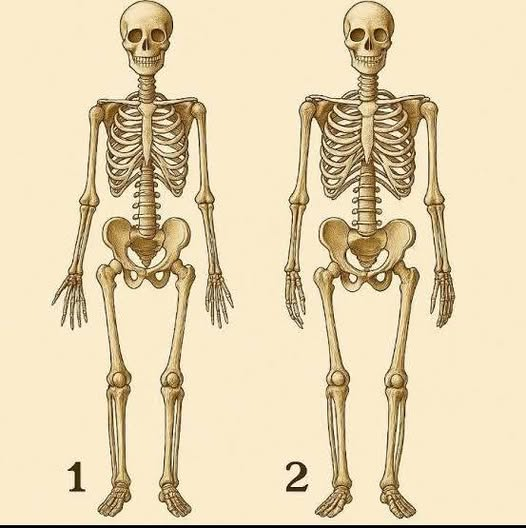
Difference between male and female skeletons
The pelvis is the most sexually dimorphic part of the human skeleton, adapted in females to facilitate childbirth:
• Female Pelvis: Wider, shallower, and shaped more like a basin. The pelvic inlet is large and round/oval-shaped, the subpubic angle is wide (typically greater than 90° to 100°), and the greater sciatic notch is broad and shallow.
• Male Pelvis: Narrower, deeper, and shaped like a funnel. The pelvic inlet is smaller and heart-shaped, the subpubic angle is narrow (typically under 90°), and the greater sciatic notch is narrow and deep.
The Skull
Skeletal features of the cranium and mandible reflect differences in muscle mass and bone size:
• Female Skulls: Generally smaller and lighter with smoother bone surfaces. They feature a more vertical and rounded forehead, less prominent brow ridges, sharper upper eye margins, a smaller mastoid process behind the ear, and a pointier chin with an obtuse jaw angle.
• Male Skulls: Generally larger and heavier with more pronounced muscle attachment lines. They feature a sloping forehead, prominent brow ridges, a larger mastoid process, and a broader, squarer chin with a more acute (vertical) jaw angle.
General Size and Robustness
• Male Skeletons: Typically thicker, heavier, and rougher with prominent bumps and ridges (where larger muscles attach). Males generally have denser bones, wider shoulders, and longer limbs relative to body size.
• Female Skeletons: Generally more gracile (slender and smoother) with lighter bone mass, though females often display higher bone mineral density in specific areas like the spine and pelvis during certain life stages.
Key Differences Between Male and Female Skeletons
overall the female skeleton has more of a basin shape whereas the male skeleton has more of a funnel shape